

Stainless Steel vs Hot Dip Galvanized Puddle Flange
Stainless Steel Puddle Flange vs Hot Dip Galvanized Puddle Flange: Which One Should You Specify?
If you’ve already read our guide to what a puddle flange is, you know the component’s job: stop water tracking along a pipe where it passes through concrete. The material question that comes up next, almost every time, is whether to specify stainless steel or hot dip galvanized (HDG) steel. Both show up in supplier catalogues, both look similar on a drawing, and both get quoted at very different price points — which is usually when the question lands on a procurement manager’s desk.
This page compares the two head-to-head on the factors that actually matter for a buying decision: corrosion resistance, lifespan, cost, and application fit, then gives a straight answer on which one to choose and when.
The Core Difference
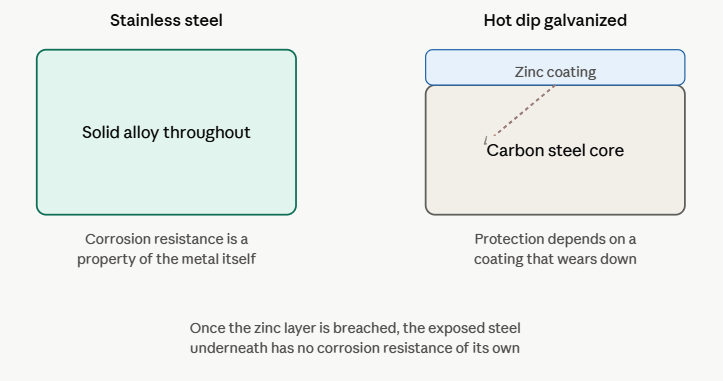
A stainless steel puddle flange is solid corrosion-resistant alloy all the way through — the corrosion resistance is a property of the metal itself (chromium forms a passive oxide layer that self-heals if scratched).
A hot dip galvanized puddle flange is carbon steel with a zinc coating applied by dipping the fabricated part in molten zinc. The corrosion resistance is a property of the coating, not the base metal. The steel underneath has no corrosion resistance of its own — it’s protected only as long as the zinc layer, and the sacrificial protection the zinc provides at scratches and edges, remain intact.
That single distinction — solid alloy vs coated base metal — drives almost every other difference on this page.
It’s worth being precise about why each material behaves the way it does, because the mechanism explains where each one is likely to fail. Stainless steel’s resistance comes from chromium content (a minimum of around 10.5% by standard definition, though structural and water-contact grades typically run 16-18%) reacting with oxygen to form a thin, transparent chromium oxide layer on the surface. This passive layer is the actual barrier against corrosion, and its defining feature is that it self-repairs: if the surface is scratched, scuffed during handling, or abraded by aggregate during the concrete pour, exposed chromium reacts with oxygen again almost immediately and reforms the protective layer. This is why stainless steel doesn’t have a “coating life” in the way galvanized steel does — there’s no depleting layer to run out.
Hot dip galvanizing works on an entirely different principle. The zinc coating protects the underlying steel in two ways: as a physical barrier that keeps water and oxygen away from the steel, and as a sacrificial anode — if the coating is damaged and steel is exposed, zinc immediately adjacent to the damage corrodes preferentially and continues to protect the exposed steel, but only for as long as there’s zinc left nearby to sacrifice. Once the zinc in that area is consumed, the barrier and the sacrificial protection are both gone, and the exposed steel corrodes on its own from that point forward. This is a fundamentally finite protection mechanism, and it’s the reason galvanized components carry a genuine, calculable service life rather than an indefinite one.
Corrosion Resistance
Stainless steel resists corrosion continuously and uniformly across the whole part, including at welds, cut edges, and any point where the surface is damaged during handling or installation. This matters specifically for puddle flanges because the weld itself is the critical waterproofing joint — and stainless steel maintains its resistance right up to and through the weld heat-affected zone (with proper welding practice), whereas HDG parts typically require a separate cold-galvanizing repair compound at the weld after fabrication, since the original zinc coating is burned off by the welding heat.
Hot dip galvanized protection works by the zinc coating corroding sacrificially in place of the steel, and by acting as a barrier while it remains intact. Two things erode this over time:
- Zinc coatings have a finite thickness, so they wear down and eventually expose bare steel to underlying corrosion
- In concrete specifically, the alkaline environment can react with zinc, and any coating damage during installation or from concrete abrasion during placement creates an immediate weak point
- Once the coating breaches at any single point, corrosion of the base steel begins right there, and rust expansion at that spot can crack the surrounding concrete — undermining the very seal the flange is meant to provide
Where each holds up:
| Environment | Stainless Steel | Hot Dip Galvanized |
|---|---|---|
| Fresh water, low chloride | Excellent | Good |
| Wastewater / variable chemistry | Excellent (316 grade) | Poor to fair — chloride and pH swings degrade zinc faster |
| Coastal / marine exposure | Excellent (316 grade) | Poor — chlorides accelerate zinc consumption significantly |
| Buried in chloride-contaminated soil or de-icing salt runoff | Excellent | Poor |
| Dry, above-grade, low-risk application | Excellent (arguably over-specified) | Good |
One additional factor worth flagging for anyone specifying below-grade work: soil chemistry varies significantly from site to site, and it’s rarely tested for galvanizing suitability specifically. Soils with high sulfate content, low resistivity, or variable pH accelerate zinc consumption in ways that aren’t always obvious from a standard geotechnical report. Where a project has any soil contamination history, a high water table, or proximity to a road salted in winter, this is a reasonable point to raise with the geotechnical engineer before committing to galvanized steel for an inaccessible penetration.
Lifespan
This is where the difference becomes concrete rather than theoretical.
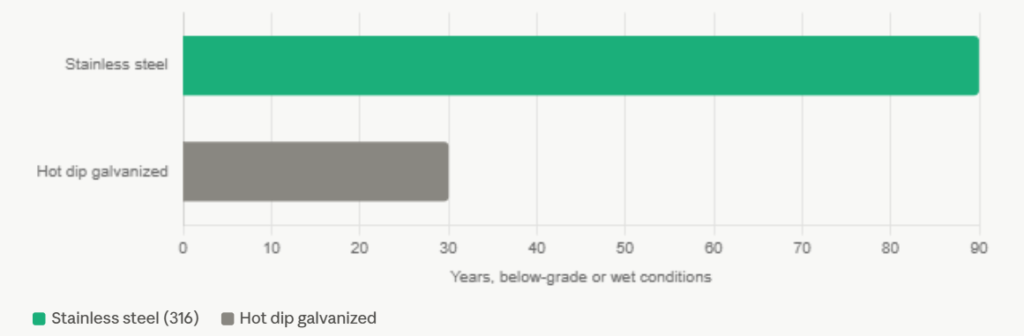
A properly specified 316 stainless steel puddle flange in a below-grade or water-retaining application is generally expected to match the design life of the structure itself — commonly 50-100 years for civil infrastructure — with no maintenance intervention, because there’s no coating to deplete.
A hot dip galvanized puddle flange has a finite, coating-thickness-dependent service life. Standard HDG coatings (per ASTM A123 / ISO 1461) are typically specified in the 85-140 micron range depending on steel thickness, and in a buried, wet, or chemically variable environment, published corrosion-rate data generally puts realistic zinc coating life in the range of 20-40 years — sometimes considerably less in aggressive soils or wastewater contact — after which the coating is consumed and the base steel is exposed with no further protection.
The practical problem: a puddle flange is, by design, permanently embedded and inaccessible once concrete is cast. There is no re-galvanizing, recoating, or maintenance option once it’s in the slab. If the zinc life is shorter than the structure’s design life — which it usually is in wet or below-grade conditions — the flange becomes the weak point of the entire waterproofing detail, and the failure mode (corrosion, expansion, cracking) happens exactly where you can’t inspect or repair it.
It’s also worth understanding what the failure sequence actually looks like, because it isn’t a single sudden event. Zinc consumption is gradual and gets faster once the coating thins past a certain point, since a thinner layer offers proportionally less sacrificial protection per unit area. In practice this means the last several years of a galvanized coating’s life see corrosion accelerate, rather than a clean, predictable cutoff. Once bare steel is exposed at even one point, rust forms, and rust occupies roughly six to ten times the volume of the steel it replaces. That expansion generates pressure directly against the surrounding concrete, and concrete has very little tensile capacity — it’s this expansion, not the water ingress itself, that typically causes the first visible sign of a failing embedded flange: hairline cracking or spalling in the concrete immediately around the penetration. By the time that’s visible, the corrosion has usually been progressing for some time already, unseen.
Cost Comparison
| Factor | Stainless Steel (316) | Hot Dip Galvanized |
|---|---|---|
| Material cost | Higher — typically 2-4x the raw material cost of carbon steel | Lower base material (carbon steel) plus galvanizing process cost |
| Fabrication/welding cost | Requires stainless welding consumables and process control; moderately higher labor cost | Standard carbon steel welding, generally cheaper labor; galvanizing done after fabrication as a separate process step |
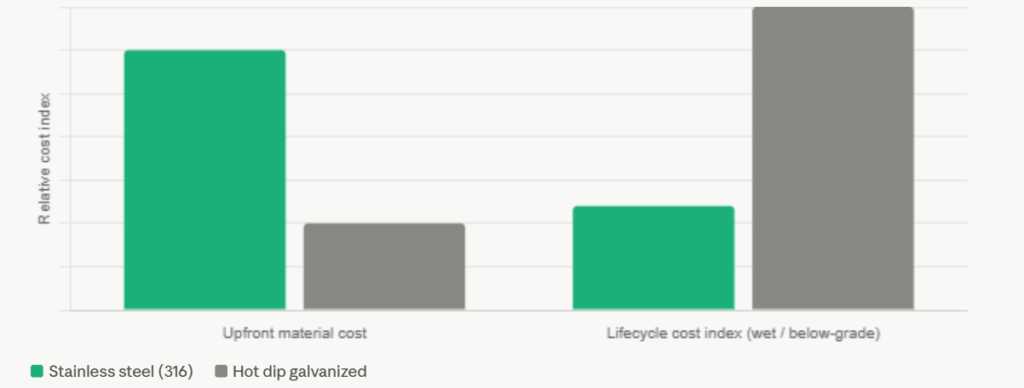
| Upfront project cost | Higher | Lower |
| Lifecycle cost (below-grade / wet applications) | Lower — no replacement or remedial waterproofing repair expected within structure lifespan | Higher — risk of premature failure requiring invasive slab/wall repair, which costs far more than the original material price difference |
| Lifecycle cost (dry, above-grade, low-risk applications) | Often unnecessarily high for the risk level | Generally the more cost-effective choice |
The upfront number tells only half the story. If a below-grade puddle flange fails at year 25 because the galvanizing has worn through, the repair cost — breaking out concrete, addressing water ingress damage, re-waterproofing — is typically many multiples of what the stainless steel option would have cost at the outset. This is the calculation most experienced specifiers run before signing off on galvanized for a critical, inaccessible penetration.
Applications: Where Each One Actually Fits
Choose stainless steel when:
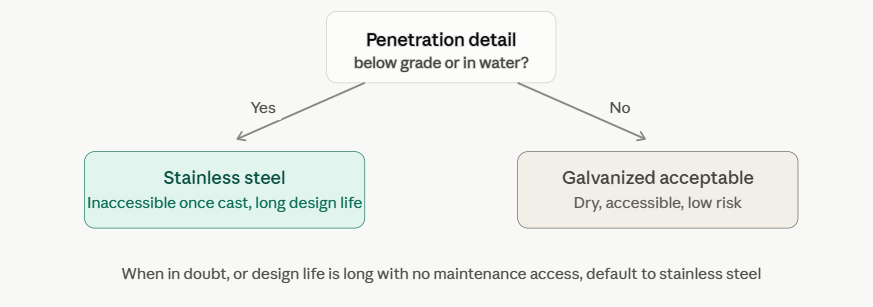
- The flange will be permanently embedded below grade or underwater
- The application is a water-retaining structure (tank, reservoir, treatment plant, pump station)
- There’s any coastal, chloride, or de-icing salt exposure
- The structure has a long design life (typical civil infrastructure) and no maintenance access
- The project specification or client standard mandates a minimum design life that galvanizing can’t reliably meet
Hot dip galvanized can be a reasonable choice when:
- The application is above-grade, dry, and low water-pressure exposure
- The penetration is accessible for future inspection or replacement if needed
- Budget constraints are a primary driver and the risk profile is genuinely low
- The project’s expected service life is shorter than the realistic galvanizing lifespan for that environment
In practice, most civil engineers and MEP consultants working on basements, tanks, treatment plants, and any structure with groundwater contact default to stainless steel as the specification standard, and reserve galvanized for genuinely low-risk, dry, above-grade, or budget-constrained scopes where the failure consequence is minor and repairable.
Quality Verification: What to Ask For Before You Order
Because a puddle flange becomes inaccessible the moment concrete is cast, it’s one of the few components on a project where there’s no opportunity to catch a fabrication defect after installation. That makes pre-installation verification more important here than on most other steelwork, and procurement teams should build a few checks into the purchase order regardless of which material is chosen.
For stainless steel puddle flanges, ask for:
- Mill certificates confirming grade and chemical composition, commonly issued to EN 10204 3.1
- Weld inspection records — visual as a minimum, dye penetrant testing for critical or water-retaining applications
- Confirmation of post-weld passivation or pickling, since heat from welding can degrade the chromium oxide layer locally, and a proper passivation treatment restores it before the part goes into concrete
- Surface finish confirmation, since a mill finish is standard but some water-contact specifications call for a pickled and passivated finish specifically
For hot dip galvanized puddle flanges, ask for:
- Coating thickness test certificates confirming compliance with ASTM A123 or ISO 1461, ideally with measurements taken at multiple points on the part rather than a single spot check
- Confirmation of how weld zones were treated after galvanizing, since the galvanizing process typically happens after fabrication and weld areas can end up with a different coating thickness than the rest of the part
- Visual inspection sign-off for coating defects — bare spots, excessive roughness, or ash inclusions are all things a fabricator should be checking before the part ships
Neither of these checklists is exotic or unusual to ask for — most reputable fabricators provide this documentation as standard practice. The point is simply that procurement should request it explicitly and file it against the project record, since it’s the only verification that will exist once the part is cast into concrete.
Which One Should a Buyer Choose?
As a working rule:
- Below grade, in water, in a water-retaining structure, or anywhere inaccessible once installed → stainless steel (316 for coastal/wastewater, 304 acceptable for benign freshwater conditions). The lifecycle cost argument almost always favors stainless once you account for the cost of a below-grade repair.
- Above grade, dry, accessible, and genuinely low-risk → hot dip galvanized is a defensible, lower-cost choice, provided the specification explicitly accepts the shorter realistic service life.
- When in doubt, or when the structure’s design life is long and maintenance access is limited → default to stainless steel. The price premium at the buying stage is small relative to the cost of getting this decision wrong on an inaccessible detail.
If your project specification doesn’t explicitly call out a grade, it’s worth raising the question with the structural engineer or client before ordering — this is exactly the kind of detail that’s cheap to fix on a drawing and expensive to fix in a finished structure.
Frequently Asked Questions
Is hot dip galvanized cheaper than stainless steel for puddle flanges?
Yes, upfront material and fabrication cost is generally lower for galvanized. However, for below-grade or water-retaining applications, the lifecycle cost — factoring in realistic coating life and the cost of remedial repair if it fails — often favors stainless steel once the full service life is considered.
Can a galvanized puddle flange be used below grade?
It can be installed below grade, but it’s generally not recommended for long-design-life or inaccessible structures, since the zinc coating has a finite lifespan and cannot be maintained or recoated once embedded in concrete. Most specifications for below-grade water-retaining structures call for stainless steel instead.
Does welding damage the galvanized coating?
Yes. Welding burns off the zinc coating in the heat-affected zone, and this area typically needs a separate cold-galvanizing repair compound applied after fabrication — which is a weaker, less durable protection than the original hot dip coating, and represents a point of vulnerability right at the weld, which is the critical waterproofing joint on a puddle flange.
How much longer does stainless steel last compared to galvanized in this application?
There’s no fixed multiplier, since it depends heavily on the local environment, but as a general pattern, galvanized coatings in wet or below-grade conditions are commonly expected to last in the range of 20-40 years before the zinc is consumed, while a correctly specified 316 stainless steel flange is generally expected to match the structural design life of the surrounding concrete with no coating to deplete.
What grade of stainless steel should I use instead of galvanized?
304 stainless is a reasonable substitute for galvanized in freshwater, non-coastal, general below-grade use. 316 stainless is the appropriate substitute wherever galvanized would have been marginal anyway — coastal exposure, wastewater, or any chloride-rich environment — since 316’s molybdenum content specifically targets the corrosion mechanism that would have shortened a galvanized coating’s life in the same conditions.
Can you tell a galvanized puddle flange is failing before it leaks?
Not reliably from the outside once it’s embedded. The typical visible warning sign is hairline cracking or spalling in the concrete immediately around the penetration, caused by the volume expansion of rust forming under the surface. By the time this is visible, corrosion has usually been active for some time, since the concrete itself has to absorb a fair amount of expansive pressure before it cracks. This is one of the main reasons inaccessible below-grade penetrations are generally specified in a material that doesn’t rely on a depleting coating in the first place.
Is there a hybrid option, like a galvanized flange with an additional coating?
Some suppliers offer galvanized parts with an additional epoxy or polymer topcoat, sometimes called a duplex system, which does extend service life somewhat by protecting the zinc layer itself. However, for a permanently embedded, inaccessible application, this still introduces two depleting layers instead of one rather than solving the underlying issue, and most specifications for critical water-retaining structures don’t treat it as an equivalent alternative to solid stainless steel.
Related Reading
- What Is a Puddle Flange? Complete Guide 2026 — full explainer covering how puddle flanges work, standards, sizing, and installation practice
- Stainless Steel Grade Guide: 304 vs 316 vs Duplex (suggested follow-up page)
- Waterstop Systems for Water-Retaining Structures (suggested follow-up page)
Need Help Deciding for Your Project?
Send us your pipe schedule, slab or wall detail, and site conditions (below grade, coastal, wastewater, etc.), and our technical team will recommend the right material grade and provide a specification-matched quote — including mill certificates and weld testing where required.
Request a technical quote today — our engineers respond within one business day.