

What is a Puddle Flange
Complete Guide 2026
In this Guide:
- What is a Puddle Flange?
- Why is it important?
- Types of puddle flanges
- Stainless Steel vs HDG
- Applications
- Installation Guide
- FAQs
What is a Puddle Flange?
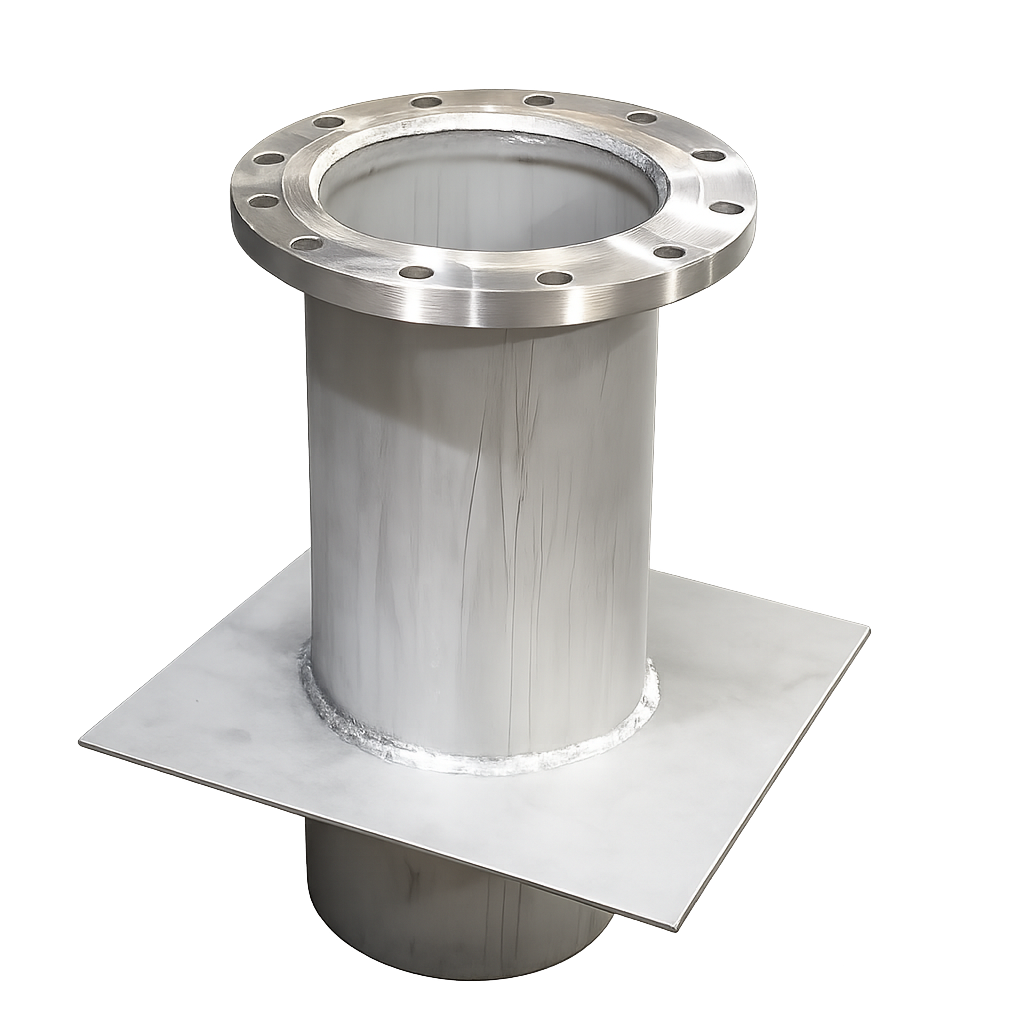
A puddle flange is a welded or cast collar fitted around a pipe at the point where it passes through a concrete slab, wall, roof, or tank base. Its job is simple to state and easy to get wrong in practice: stop water from tracking along the outside of the pipe once the concrete has cured around it. For anyone specifying waterproofing details on a basement slab, a roof drain, a water treatment tank, or a below-grade duct bank, the puddle flange is one of those small components that determines whether a penetration detail actually works for 30 years or starts leaking in year three.
This guide covers what a puddle flange is, how it works, where it’s used, material selection (with a focus on stainless steel), sizing and standards, installation practice, and the questions procurement and design teams ask most often.
What Does a Puddle Flange Actually Do?
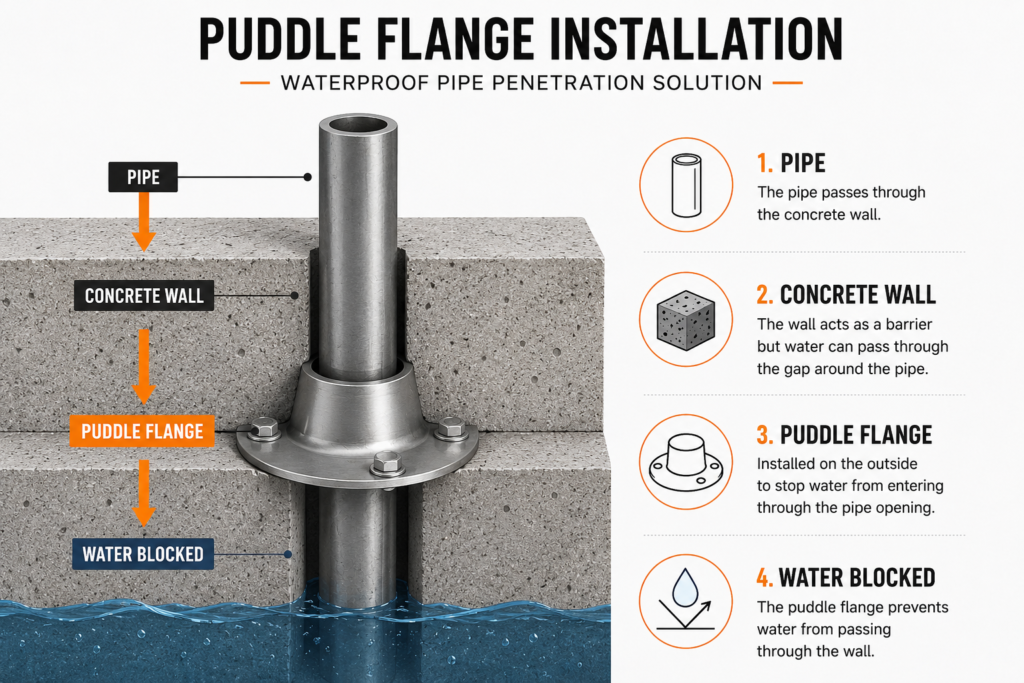
Concrete is porous and it cracks. Even a well-placed, well-vibrated pour will develop microcracking as it cures, and the interface between a smooth pipe wall and surrounding concrete is a natural path for water migration — engineers sometimes call this the “capillary path” or “tracking path” along the pipe.
A puddle flange interrupts that path. It’s a disc or ring, typically welded concentrically to the pipe, that sits fully embedded within the concrete pour. Because the flange has a larger diameter than the pipe and extends outward on both faces, water trying to travel along the pipe surface has to detour around the plate — effectively lengthening the leak path to the point where it becomes impractical for water to migrate through by capillary action or hydrostatic pressure.
This differs from a standard pipe flange, which is a bolted connection joint between two pipe sections or a pipe and a valve. A puddle flange is not a mechanical joint — it’s a waterproofing collar, and in most designs it’s welded onto the pipe as one continuous, watertight assembly before the pipe is set in formwork.
Puddle Flange vs Other Pipe Penetration Seals
Design teams often have to choose between a few penetration strategies. Here’s how puddle flanges compare to the alternatives most commonly specified.
| Method | How it works | Best suited for | Limitations |
|---|---|---|---|
| Puddle flange | Welded metal collar cast directly into concrete, forming a permanent bond | New-build concrete slabs, tank walls, basement penetrations, water-retaining structures | Must be installed before or during the pour; not retrofittable without breaking out concrete |
| Puddle pipe (puddle flange integrated into pipe run) | A longer section of pipe with the flange welded mid-length, supplied as one factory unit | High-value or critical waterproofing where site welding is undesirable | Higher upfront cost; needs accurate slab thickness coordination |
| Rubber/EPDM wall sleeve with water bar | Mechanical compression seal around a sleeve, sometimes with a separate water bar | Retrofit work, mechanical/electrical penetrations, smaller diameter services | Rubber degrades faster than stainless steel; relies on ongoing compression |
| Link-Seal (modular mechanical seal) | Rubber links compressed with bolts inside an annular gap | Retrofit penetrations through existing walls | Requires an oversized core-drilled hole; seal integrity depends on torque and rubber life |
| Cast-in wall sleeve only (no flange) | Plain sleeve set into formwork, sealed later with sealant or grout | Non-critical, above-grade, low water-pressure penetrations | Provides no capillary break; relies entirely on sealant, which fails over time |
For anything below grade, in contact with groundwater, or part of a water-retaining structure (tanks, basements, pump stations, water treatment plant walls), a puddle flange is generally the preferred detail because it’s a permanent, mechanically bonded barrier rather than a compression or sealant-dependent one.
Why Stainless Steel Is the Default Material Choice
Puddle flanges are manufactured in carbon steel, galvanized steel, and stainless steel, and occasionally in uPVC or HDPE for lightweight drainage applications. For anything involving potable water, wastewater, chemical exposure, or long design life expectations, stainless steel is the specification most consulting engineers land on, for a few concrete reasons rather than a general preference:
- Corrosion resistance in a wet, alkaline environment. Concrete is alkaline when cured, and the flange sits in permanent contact with moisture, chlorides (especially in coastal or de-icing-salt-exposed structures), and sometimes aggressive soil conditions. Carbon steel corrodes at the embedded interface, and once corrosion starts at a puddle flange, it can actually undermine the very seal it’s meant to provide, because rust expansion cracks the surrounding concrete.
- No coating to fail. Galvanized flanges rely on a zinc coating that sacrifices itself over time. In a buried, inaccessible detail, that’s a maintenance liability — nobody is going to dig up a slab to recoat a flange.
- Weldability and consistency. Grade 304 and 316 stainless steel weld cleanly to stainless pipe, which matters because the weld itself is the primary waterproofing joint, not a bolted or sealant connection.
- Grade selection matters. 304 stainless is adequate for most fresh water and general below-grade use. 316 stainless, with its molybdenum content, is the standard choice for coastal projects, wastewater with higher chloride content, or any application where long-term chloride exposure is expected. Some marine and desalination projects specify 316L or duplex grades.
Stainless Steel Grade Comparison for Puddle Flanges
| Grade | Composition highlight | Typical use case | Relative cost |
|---|---|---|---|
| 304 / 304L | 18% Cr, 8% Ni | Freshwater, general drainage, basements away from coastal exposure | Baseline |
| 316 / 316L | 16-18% Cr, 10-14% Ni, 2-3% Mo | Wastewater, coastal structures, tanks with variable water chemistry | ~20-30% above 304 |
| Duplex (2205) | Higher Cr, Mo, N; austenitic-ferritic structure | Aggressive chemical exposure, high-pressure water retaining structures | Significantly higher; used selectively |
Where Puddle Flanges Are Used
- Basement and below-grade wall penetrations for drainage, water supply, and sump discharge pipework
- Water and wastewater treatment plants, where tank walls and slabs are penetrated by inlet, outlet, and overflow pipework
- Below-grade duct banks and cable sleeves, occasionally, to prevent water tracking along conduit
- Roof and podium slab penetrations for rainwater outlets, particularly on structures with green roofs, blue roofs, or inverted warm roof buildup
- Reservoirs, attenuation tanks, and pump stations, where hydrostatic pressure on the outside of the structure makes a capillary break essential
- Marine and coastal infrastructure, where 316 stainless is typically mandated in the specification
Sizing and Standards Considerations
There isn’t a single universal dimensional standard for puddle flanges the way there is for pipe flanges (ANSI B16.5, EN 1092-1, etc.), because puddle flange design is driven more by waterproofing performance than by pressure rating. That said, a few conventions and reference points come up consistently in specifications:
- Flange diameter is typically sized at 50-100mm larger than the pipe outside diameter on each side, giving a projection wide enough to meaningfully extend the water path without becoming impractical to cast around.
- Plate thickness is usually matched to the pipe wall thickness or slightly heavier, commonly in the 6-12mm range for typical drainage and service pipe sizes, scaling up for larger diameter or higher-pressure applications.
- Weld quality is the critical performance factor. A full-penetration, continuous fillet or butt weld around the full circumference is standard practice; intermittent or tack welding defeats the purpose of the detail.
- Manufacturing is frequently referenced against EN 10088 (stainless steel flat products) for the plate material and ASTM A312 / A182 for the pipe and fitting stock, with the finished puddle flange fabricated to the project’s own waterproofing specification rather than a single dedicated flange standard.
- Some specifications call up BS 8007 or the relevant national water-retaining structure code for guidance on waterstop and penetration detailing generally, even though puddle flanges themselves sit outside a single dedicated dimensional standard.
Because there’s no single governing dimensional standard, the practical approach for procurement is to specify: pipe size and schedule, flange outside diameter, plate thickness, material grade, weld type, and any factory testing requirement (e.g., dye penetrant testing of the weld) directly in the purchase order or drawing, rather than relying on a standard number alone.
Installation Best Practice
A puddle flange is only as good as its installation. Common failure points worth flagging to site teams and reviewing at inspection:
- Concrete consolidation around the flange. Poor vibration leaves voids or honeycombing directly behind the plate, which recreates the very leak path the flange is meant to prevent. This is the single most common cause of puddle flange failures in practice, and it’s a placement issue, not a product defect.
- Correct orientation and embedment depth. The flange should sit centrally within the slab or wall thickness, with adequate concrete cover on both faces — as a guide, at least 75-100mm of cover is common practice, though this should follow the structural engineer’s detail.
- Weld integrity before casting. Once concrete is poured, a defective weld is effectively inaccessible. Visual inspection, and dye penetrant testing on critical projects, should happen before the pipe goes into formwork.
- Coordination with waterstops. On water-retaining structures, puddle flanges are often installed alongside separate waterstop systems at construction joints; the two need to be detailed together, not as an afterthought.
- Protecting the flange during the pour. Formwork ties, rebar fixing, and concrete placement can knock a flange out of alignment before the pour sets. A quick position check immediately before and after pour helps avoid rework.
Specifying a Puddle Flange: What Procurement Needs From Design
To avoid back-and-forth on quotations, an EPC or procurement team should expect the following on a puddle flange drawing or spec sheet:
- Pipe nominal size and schedule/wall thickness
- Material grade (304, 316, or project-specific alternative)
- Flange outside diameter and plate thickness
- Overall length of the puddle pipe assembly, if factory-welded as one unit
- Weld type and any NDT requirement
- Surface finish (mill finish is standard; pickled and passivated finish is common for water contact applications)
- End connection type (plain end for site welding, flanged end, or grooved end)
- Quantity, lead time, and any material traceability/mill certificate requirement (commonly EN 10204 3.1)
Frequently Asked Questions
What is the difference between a puddle flange and a puddle pipe?
A puddle flange is the plate itself, welded onto a pipe on site or in a fabrication shop. A puddle pipe is a complete factory-fabricated assembly — pipe plus flange, supplied as one unit to a specified overall length — used when the project wants the weld quality controlled in a shop environment rather than on site.
Do puddle flanges need to be stainless steel?
No, but stainless steel is the standard choice wherever long-term corrosion resistance matters, particularly below grade, in water-retaining structures, or in coastal environments. Carbon steel and galvanized options exist for lower-risk, above-grade, or short-design-life applications, but they carry a higher long-term maintenance and failure risk.
What size flange do I need for a given pipe diameter?
There’s no fixed universal ratio, but a common rule of thumb is a flange projecting 50- 100 mm beyond the pipe outside diameter on each side. The exact size should be confirmed against the project waterproofing specification and structural detail, since concrete cover and slab thickness both affect the workable flange size.
Can a puddle flange be retrofitted into existing concrete?
Not in the traditional cast-in sense. Puddle flanges are designed to be embedded during the concrete pour. For existing structures, mechanical alternatives like Link-Seal systems or resin-injected sleeves are used instead, since they don’t require breaking out and recasting concrete around a new welded flange.
What’s the difference between 304 and 316 stainless for a puddle flange?
316 stainless contains molybdenum, which significantly improves resistance to chloride-induced corrosion. 304 is generally sufficient for freshwater and general below-grade use; 316 is specified where there’s coastal exposure, de-icing salt runoff, or wastewater with higher chloride content.
Does a puddle flange replace the need for a waterstop?
No. On water-retaining structures, puddle flanges address pipe penetrations specifically, while waterstops address construction joints between concrete pours. Both are typically required on the same structure, detailed to work together rather than as substitutes for one another.
Get a Quote on Stainless Steel Puddle Flanges
If you’re preparing a bill of materials, finalizing a waterproofing detail, or sourcing puddle flanges for an active project, our technical sales team can turn around sizing, grade recommendations, and lead times against your drawings. Send over your pipe schedule and slab detail, and we’ll come back with a specification-matched quotation, including mill certification and weld testing options where required.
Request a technical quote today — our engineers respond within one business day.